Choosing between a charcoal grill vs gas grill isn't just a backyard flavor debate when you're buying containers for a retail chain. For category managers, importers, and private-label brands, the fuel split determines your landed freight cost, your compliance timeline, your warranty exposure, and how fast seasonal inventory clears before autumn markdowns. Get the mix wrong and you'll either leave margin on the table or tie up working capital in bulky cartons that miss the spring sell-in window.
In our engineering archive at KEYO, we've manufactured both lines in Foshan since 1998 for global supermarkets including Walmart, Costco, Aldi, Auchan, Tesco, Sodimac, and Carrefour. That long run gives us a clear view of how charcoal and gas SKUs actually behave once they leave the factory floor. Below, you'll find a practical B2B breakdown covering container math, safety testing, manufacturing lead times, and shelf positioning so you can build a balanced seasonal plan.
1. Landed Cost, Carton Volume, and Container Economics
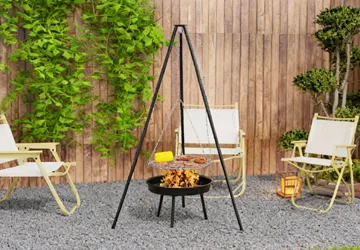
Ocean freight can quietly make or break an outdoor living program. Charcoal grills win decisively on cube efficiency because their bowls, lids, and bolt-on legs nest cleanly inside flat-pack cartons. Take a look at our KY1817B freestanding barrel charcoal grill: it packs down to 77.5 × 43 × 22.5 cm (0.075 m³), fitting roughly 370 units into a 20GP container. On our YH22017D enamel kettle series, optimized nesting pushes container loading up to 1,600 units in a 40HQ depending on diameter.
Gas grills tell a different story. Multi-burner fireboxes, welded cart frames, side shelves, electronic pulse ignition modules, and stainless double-layer hoods all add weight and carton volume. You ship fewer units per 40HQ, which raises freight per unit. Yet retail buyers still devote prime end-cap space to 3-burner and 4-burner propane models because the average retail ticket is significantly higher. Say you manage a 40-store garden center chain: you'll often use high-density charcoal grills to drive foot traffic at an accessible opening price point, while gas grills anchor your mid-tier and premium margin tiers.
| Procurement Factor | Charcoal Grills (Kettle / Barrel / Portable) | Gas Grills (2–4 Burner / Griddle / Combo) |
|---|---|---|
| Container Density | High (flat-pack nesting; up to 1,600 units/40HQ on select kettles) | Moderate (heavier burner manifolds, hoods, and cart frames) |
| Core Market Standards | GS EN1860-1, LFGB, DGCCRF, FDA, REACH | CE / UKCA (EU Gas Regulation), LFGB/FDA; CSA/AGA options |
| Pre-Shipment Factory QC | Welding smoothness, enamel adhesion, structural stability | 100% ignition test, gas leak detection, heat performance test |
| Retail Price Positioning | Opening price point & promotional volume driver | Mid-to-high ticket margin anchor |
| Typical Bulk Lead Time | 30–45 days (select stock models ship in 3 days) | 30–45 days (plan extra lead time for market-specific regulators) |
2. Compliance & Testing Requirements by Target Market
Compliance is where many first-time private-label programs lose six weeks of schedule. Charcoal grills are governed in Europe primarily by EN 1860-1, which evaluates mechanical stability, handle temperatures, sharp edges, and material integrity under solid-fuel combustion. Food-contact grates and enamel surfaces must also clear German LFGB, French DGCCRF, or US FDA migration tests. Because there's no pressurized fuel train, adapting one charcoal SKU across multiple European countries usually requires little more than localized packaging and multilingual manuals.
Gas grills operate under stricter regulatory regimes. In the European Union, outdoor propane and natural gas appliances fall under the EU Gas Appliances Regulation (EU) 2016/426 (CE marking) and UKCA in Great Britain. North America requires CSA or ETL listings aligned with ANSI Z21.58, while Australia requires AGA approval. You also have to match local gas pressures, hose fittings, and cylinder regulators—a 30 mbar regulator for one market won't match a 50 mbar specification in Germany or Austria. Before we start mass production on models like our QL02-012 4-burner propane gas grill, every unit goes through factory ignition checks, leak detection, and heat performance testing under our 12-person QC team.
3. Material Durability and After-Sales Risk
Retail return rates eat directly into gross margin. On charcoal grills, the biggest failure modes are thin steel firebowls warping under high-heat lump charcoal and low-grade paint blistering after two cookouts. That's why serious retail buyers specify true porcelain-enamel firing rather than spray paint on kettle bowls and lids. Porcelain enamel handles extreme charcoal temperatures without flaking, resists outdoor rust, and wipes clean easily—reducing consumer complaints during peak summer months.
On gas grills, return risk centers on burner corrosion, grease flare-ups, and igniter reliability. Cold-rolled steel frames paired with stainless steel hoods, properly sloped grease trays, and pulse igniters cut warranty claims dramatically. Imagine an importer launching a new backyard line for Northern Europe where coastal humidity is high: upgrading grates to porcelain-enameled cast iron or anti-rust stainless steel adds only a modest factory cost increment while extending shelf reputation across multiple seasons.
4. When Dual-Fuel Combo Grills Make Sense
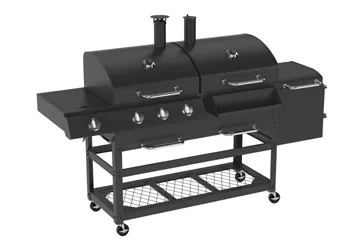
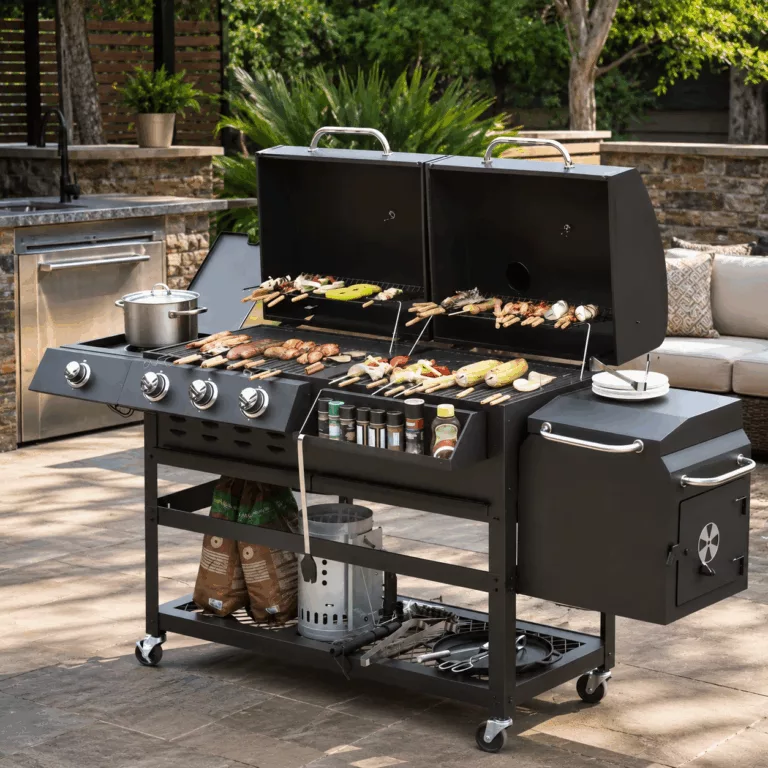
You don't always have to force shoppers into a binary choice. Across big-box home improvement stores and specialty outdoor chains, dual-fuel stations have carved out a resilient niche. Our QL01-027 gas and charcoal combo grill combines four gas burners, a 2.7 kW lidded side burner, an independent charcoal grilling zone (52 × 45 cm cooking areas), and a side smoker in one wheeled chassis.
Why do buyers love a hero combo SKU? First, it captures indecisive households who want fast weeknight propane grilling plus weekend wood-and-charcoal smoking. Second, it commands a strong retail display presence without requiring two separate floor footprints. Just remember that a dual-fuel unit carries gas-appliance compliance requirements, so lock your target market's regulator and certification specs early in the RFQ phase.
5. Building Your Seasonal Assortment & RFQ Strategy
If you're planning next season's outdoor cooking lineup, start by mapping your customer channels before requesting quotes:
- Supermarkets & Discount Chains: Lead with flat-pack 14-inch to 22-inch kettle grills and portable enamel charcoal models where container density keeps retail pricing sharp.
- DIY Garden Centers & Specialty Retailers: Pair a 22.5-inch flagship kettle (PG07-070) with a 4-burner propane grill, a flat-top griddle (QL01-061), and one dual-fuel combo station.
- E-Commerce & Private-Label Brands: Focus on differentiated silhouettes—like Santa Maria lifting-grate charcoal grills or folding camping gas grills—that avoid head-to-head price wars on generic models.
At KEYO, our standard wholesale MOQ is 500 pieces, with flexible entry tiers (50 pieces on select stock charcoal models and 100 to 200 pieces on regular kettle units). Samples ship in 7 days (3 days for stock), and bulk containers deliver in 30 to 45 days under FOB or DDP terms. Ready to compare factory-direct landed quotes for your market? Visit our OEM & ODM customization page or request a quote with your target SKU split.